
To celebrate the upcoming release of Jerry T. and the Black Alligators' new album, we are delighted to welcome Jerry T., guitarist and lead singer of this truly pure blues band. He kindly agreed to answer a few questions about the group, his projects, music, his instruments, and life in general.
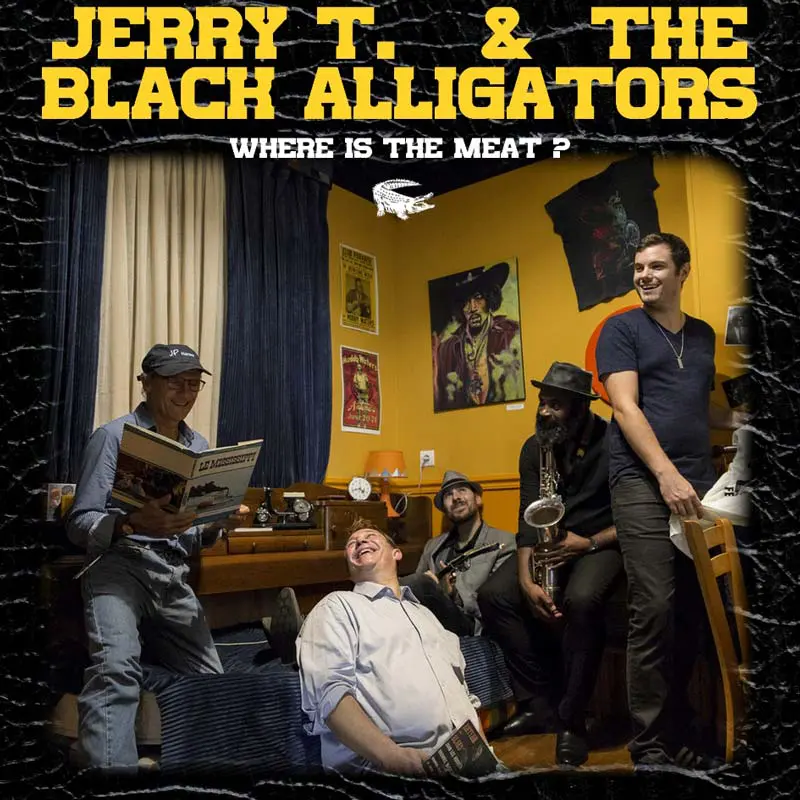
What strikes you when listening to Jerry T. and the Black Alligators' latest album, "Where Is the Meat?", isn't so much the variety or diversity of blues concentrated on a single record. That's a formula the band has already established throughout their three previous albums. No, what's striking is the mastery with which all these styles are arranged, performed, and recorded. The orchestration is flawless, the sax/harmonica horn section works wonderfully, and Jerry's solos with his Queen T., an ES-335 from the Custom Shop, are pure bliss. Any self-respecting guitarist, especially one who loves the blues, will appreciate the diversity of guitar sounds throughout this album and the ease with which Jerry moves from one to another. From acoustic blues in a Chicago club, from Memphis to the sultry bayou, Jerry T. and his Alligators treat us to all the blues with undisguised pleasure. Perhaps this is the feeling I'll remember most. A feeling that gripped me as soon as I held the album in my hands: the pleasure of doing things together, of having fun and sharing. The good humor and enjoyment the musicians have playing together is palpable right from the album cover. In this time of lockdown, when doing things together is forbidden, reminding ourselves that it's important, precious, and enjoyable is vital!
We met Jerry when he contacted our boutique (editor's note: by email, as our boutique is online only). We made him a set of Manhattan's 59 pickups, replicas of the famous MHS pickups from Gibson's Custom Shop, for his Flying V, his backup guitar on stage. It's even thanks to Jerry that these pickups are in our catalog today. He gifted us with a fantastic video where he presents the pickups , his Flying V plugged into a Val Martin Princeton '55 for a pure blues sound. Back to the roots!

Jerry T. and the Black Alligators' adventure began in 2014 and they already have 4 albums to their credit. But for Jerry, the guitar and the blues, how did it all begin?
Jerry T .: Wow, what a question! The blues is a love story! If I have to remember how it all began… I absolutely have to start with when I first started playing guitar. I started late! At 20. I was a rock and metal fan. Born in 1987, I lived through the heyday of nu metal. That was my gateway to a lot of bands considered "vintage." From Deftonesand Kornto System of a Down, I then discovered Iron Maiden, AC/DC, and Ozzy Osbourne. Initially, it was all about discovering songs with a strong emphasis on the lead guitar.
Metal back to the roots
Then I continued down that path, and AC/DC, Jack White, and Ozzy became Black Sabbath, Led Zeppelin, and The Who. Then Led Zeppelin and company became Buddy Guy, Howlin' Wolf, Jimi Hendrix , and Muddy Waters. And that's when everything changed for me. This journey through music and instruments, from one inspiration to the next, led me back to the roots of all that rock, rock 'n' roll, pop, etc. As Willie Dixon (one of the greatest blues songwriters) said, "The blues is the root, everything else is the fruit." In short, the blues is the root, and everything else is the fruit. This means that all the music we listen to today has, somewhere, a little bit of blues and the inspiration of the blues pioneers. Of course, the social and cultural aspects of the Blues resonated with me: the blending of African influences, then all kinds of influences in the southern United States, then the history of US migrations from Mississippi to Chicago, then the evolution of the Blues from the West Coast to London, and finally from Woodstock to all the variations of Rock and Pop that exist today. So, in particular, the music of Jimi Hendrix was a revolution in my approach to the guitar and its expressive possibilities. And my encounter with the music of Muddy Waters, Robert Johnson, Buddy Guy , and Howlin' Wolf plunged me into a spiral of Blues and musical emotions from which I've never emerged!
I hear the blues in the solos of Randy Rhoads, Slash, and Zakk Wylde; there's blues in what Avicii, Daft Punk, and C2C do; and I can't go to a major metal or contemporary music festival without hearing a blues track here or there. Okay, I'll stop there, otherwise we'll end up with a lecture. But seriously, listen to Muddy Waters! Listen to John Lee Hooker, and listen to Robert Johnson!
Q: We see you on stage with your Queen T., a magnificent ES-345 from the Custom Shop, but I believe you used several guitars on the album: how did you make your choice to get such different sounds?
Jerry T .: Choosing an instrument and having a relationship with a guitar is truly special. Personally, all my guitars have a story. I do everything I can to ensure that its story never becomes something like, "I ordered it from a German e-commerce site, received it two days later, and it's been my favorite ever since." No, a guitar is an adventure; you try it out, you feel it, and acquiring it can be a whimsical story that adds a background to the guitar even before you've played it. I would go to the ends of the earth to find a guitar with soul and a story all its own. I've been fortunate enough to travel and try out guitars that correspond to the sounds of a bluesman and a musician. I built a Stratocaster with the French luthier Xavier Petit, who has since passed away. I selected all the electronics, the pickups, the woods, etc. It's a superb guitar, full of nuances, with single-coil pickups perfect for blues and even Hendrix-like tones. This guitar is featured on "Won't Forget About Me," which plays with the conventions of the classic Chicago Shuffle, making it a perfect fit for this guitar.
I have a Les Paul that I brought back after a full afternoon of testing Gibson Les Pauls at Sam Ash's place in Nashville. It's a Gary Moore signature model, and I let the Burst Bucker Pro pickups blast on more blues-rock tracks like "Crossroads" and "You're Gonna Change." I have an ST1200 that's older than me! It's a Japanese Ibanez with pickups Super 70 ceramic double neck, a 6-string neck that instantly sounds like '80s heavy metal, and a very nuanced 12-string neck that allows for beautiful electric ballads (like "No Stairway to Heaven!"). This one is recorded on "Time To Settle Down." I have a Danelectro I brought back from Chicago, which I didn't record on that album, and a bluesy Flying V (with superb pickups Cecca Guitars !) for live performances, etc.
And of course, Queen T., the superb ES-345 " Jerry T. Model ," which is aMade to Measure) guitar from the Gibson Memphis factory before it closed. Quite simply the best instrument I've ever played. With its MHS (Memphis Historic Specs) humbuckers, which are truly exceptional on a hollow body. Smooth playability, sensitivity in every aspect, a tone control that really comes into play, a volume knob that transforms the world you're in, and bite when you dig in. A perfect guitar for the musician I am. In short, each guitar can correspond to certain "functions," types of sounds to explore, and types of moods that suit it. Then, sometimes a little breaking the rules and pushing instruments into uncharted territory yields wonderful surprises. In any case, yes, the choice of instruments is important from my point of view, and, as I said in the introduction to this question, it also contributes to anchoring the history of the guitar itself.

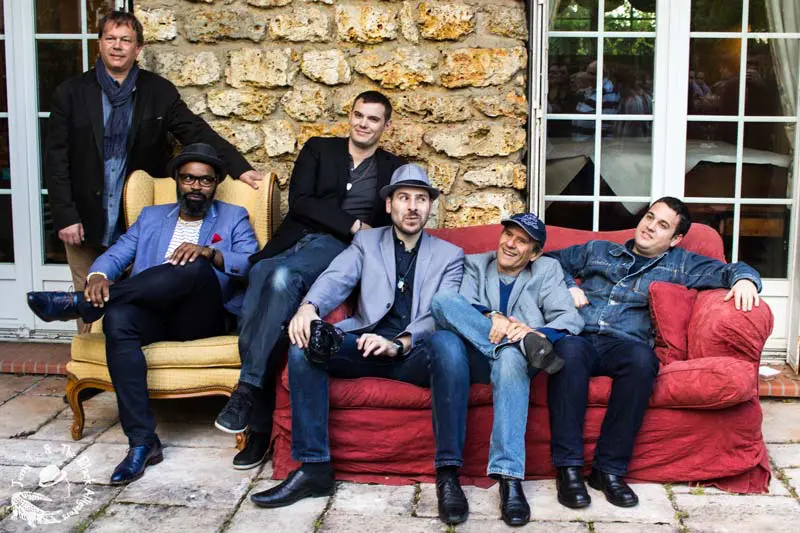

Q: The album "Where is the meat?" is released on June 4th in record stores and will be available for streaming on all platforms. What projects are planned following this album release? Any dates scheduled?
Jerry T .: We're definitely counting on it! We won't lie, we miss playing live, and obviously the contact with people. All musicians right now feel the same way. On June 4th, we're going to try to do a small digital event. And of course, we want to get back to performing for an audience as soon as possible! No concerts are planned at the moment, but we're working on it. We're trying to move beyond the "we'll sign a contract if the date is confirmed" mentality, and now that the lockdown is being lifted, maybe our opportunities to play live and promote our album and show will naturally present themselves! We're working on it, in any case, and we can't wait to be able to share our music on stage.
Q: "Where is the meat?" is both a song on the album and the album's title. Can you tell us more about this track and why you chose to feature it?
Jerry T .: Haha, Where is the Meat? The band and I chose that title for the album because it really captured our state of mind. The Alligators are hungry! We need to feed them! As a slightly dirty bluesman, this idea of feeding the Alligators can be a bit subversive—jack, meat, and good company—but also, the Black Alligators are hungry for live performances! For concerts, for stage presence, and for high-energy shows! We're really hungry for that, and the album is the perfect opportunity to shout it from the rooftops. Actually, the song title, Where is the Meat?, itself has nothing to do with any of that. It's more about questioning our relationship with what we put on our plates, from an ecological and philosophical point of view, with a lot of English wordplay around meals and the fact that our planet is always neglected throughout history. We have no intention of carrying an ecological message, especially not me, but the song itself just poses questions of this type, and does so in a fuzzy, almost 60s-style atmosphere.
Q: I believe you have other activities outside of the group but still related to music, would you like to tell us about them?
Jerry T .: Yes, anything related to Blues culture is important to me to keep alive. I'm involved in several national associations. I also write for Blues Mag, interview artists, and help promote the work of French and international Blues musicians.
I am also a photographer, I have an exhibition currently running at La Traverse, entitled " Blues en Tête d'Affiche " which presents artists on the stages of French venues and festivals.
And finally, I'm the author of a book entitled " Blues Stories ," a collection of the most in-depth and comprehensive interviews I've had the opportunity to conduct with various online and print media outlets. The book is published by Camion Blanc and will be available in June, shortly after the album's release. I'm very proud of it, and I believe the featured artists truly deserve to be seen and heard on stage and elsewhere! A good number of French artists are included, notably Gaelle Buswel, Jessie Lee & the Alchemists, Ronan Onemanband, and Fred Chapelier. It also features some international headliners: Billy Gibbons, Walter Trout, Eric Gales, Samantha Fish, and Popa Chubby—all artists who richly deserve to share their vision of the Blues and who deserve your attention if you're curious about this blend of Blues and Rock! See you on June 20th for the book's release and all the details!
Thank you Anthony for your questions, it's a pleasure to share all this with you.
To learn more:
https://www.jerrytandtheblackalligators.com
https://www.facebook.com/jerrytbluesman