
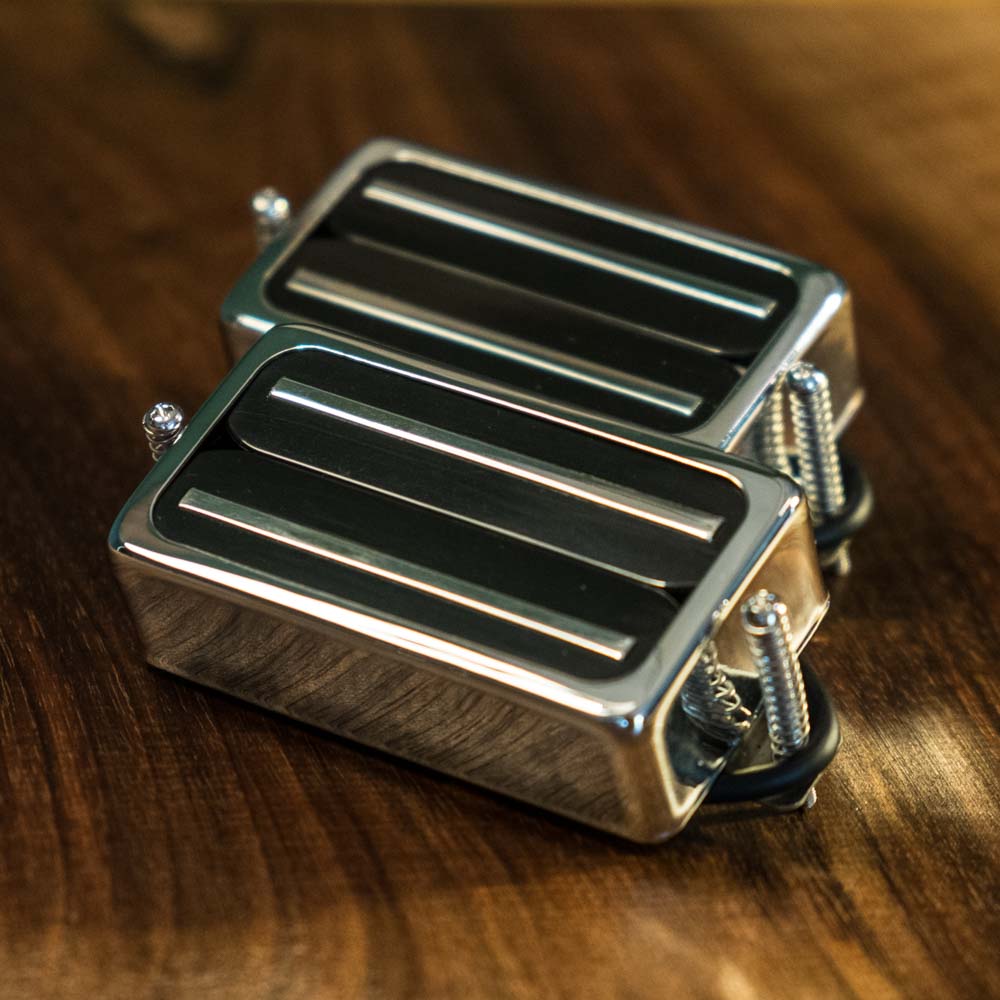
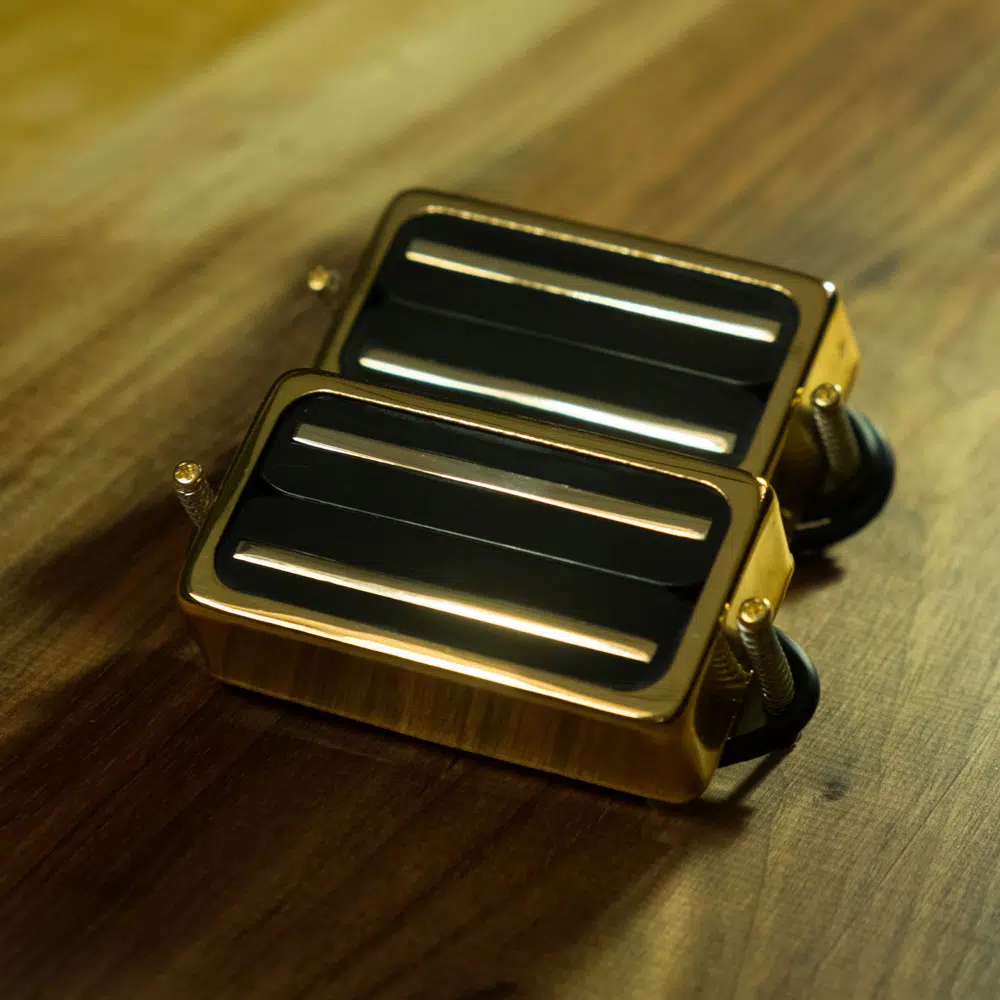
Making a new guitar pickup is always an exciting experience. You try things out, you experiment, sometimes starting with a vague idea, a simple desire to use a particular component, and other times you begin with a very specific idea in mind. When DoomFred told me about a pickup he liked, he immediately mentioned a dual-blade humbucker, with two rails instead of the traditional screws and pole pieces. During our discussions about pickups , the Dimarzio Super Distortion came up, the firsthigh -gain pickup with a ceramic magnet in the history of electric guitar, back in 1972: the beginning of the modern era. We also talked about Black Sabbath, Jimmy Page, and Dave Murray. So, the challenge was on.

For many of you, Frédéric Patte-Brasseur, aka DoomFred, is far from unknown: A player in the Metal scene for 20 years since the birth of Ataraxie and a guitarist for 27 years, Fred plays in 5 groups: Ataraxie (Doom-Death), Funeralium (Doom Extreme, next album on October 29), Stabwound (Trash-Death), Mourning Dawn (Doom-Black, as a live guitarist) and Conviction (Doom Metal) which released an excellent first album at the beginning of the year.

That's not all… Fred set up his own luthier business in Mantes-la-Ville – DFGuitars – in 2020 after 25 years of repairing and customizing electric guitars. He's a black belt in guitar electronics, meaning he can do absolutely anything electronically, with his eyes closed, no less.
To conclude this brief presentation, Fred is endorsed by Two Notes (the revolutionary professional Loadbox and speaker simulation system for guitar and bass), Skull Strings (high-end handmade strings made in France), Rikki le Plectrier (handmade picks), Musical Enthropy and Blue Cat Audio (plugins).
As an added bonus, DoomFred does mixing, for others and sometimes for his own groups, notably the latest "Conviction".
Anything else? No, just that Fred knows about electric guitar.
Q: Fred, as we saw above, you've dabbled in many things in terms of electric guitar, pickups, and sound experimentation. What were you hoping to get out of a new set of pickups ? Was it for playing a particular type of music? Were you looking for a specific sound?
DoomFred : More than just a specific sound, the idea was to bring together a number of qualities I look for in a pickup set, while referencing tried-and-tested models, particularly in Metal or Hard Rock music. My main criteria were: – a bridge pickup that allows the guitar to naturally sit in the midrange, so it cuts through the mix effortlessly.
All this to be comfortable in the different aspects of the music I play with my different groups, whether on stage or in the studio, regardless of the guitar's scale length, tuning, etc.
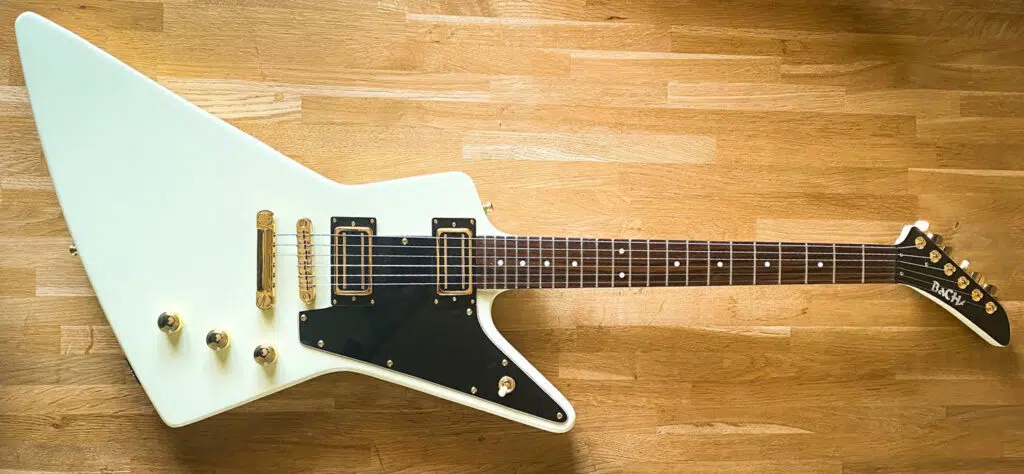

Q: You set up your guitar-making workshop in Mantes-la-Ville last year, where you do repairs, customization, and also guitar building. What are your plans in this area? What guitar models do you have, and would you like to build? And what is your signature style in terms of design, configuration, and overall aesthetic?
DoomFred : My priority, my main project, is first and foremost to ensure the workshop's long-term viability, which involves listening to the needs of the musicians who come to me and offering them the best possible solutions. Being a musician before being a luthier, this is a true credo for me.
Regarding my own projects, I have several guitar designs in the prototyping stage, which I haven't had much time to work on recently. There's my own reinterpretation of "pointed" models (Explorer, Flying V), which has been on my mind for about ten years, but also an offset-style model (Mustang/Jaguar) and a model inspired by the golden age of the Japanese electric guitar on my drawing board.
In terms of design, what obsesses me is the guitar's ergonomics. Will my hands fall naturally into the playing position? Is the guitar balanced when held standing up? Is it easy to play sitting down? I also have a lot of questions about the electronics, the necessary controls, and their placement. Especially since the needs aren't the same depending on whether you're playing live or in the studio, and you have to find the right balance between ease of use and the versatility you might want.
Q: You're one of those guitarists deeply involved in sound (studio mixing, instrument making, studio/live recording) and you were part of the Two Notes adventure from the very beginning. Your gear collection is nothing short of impressive. What advice would you give to a young guitarist with limited resources to properly equip themselves for all situations: live performances, recording, and demos at home? Has the legendary 30-kilo tube amp lost its edge, or is it still relevant?
DoomFred : The legendary tube amp still holds its own, it's no wonder that most products try to reproduce its sound cheaply! For my part, that's what I use in the vast majority of cases on stage, I build my sound around the tone of an amp and add my own "spices" around it.
To a complete beginner looking for versatility, I'd recommend one of those units designed from the ground up with that in mind, like a Line 6 Helix Stomp, or a good quality used multi-effects unit, for example. They're not the most user-friendly, but they're true Swiss Army knives! Plus, with a bit of searching, you can find some real gems at reasonable prices, especially rackmount units, since that format has become less common. A Rocktron Voodu Valve, for instance, is still very relevant today.


Q: We recently heard you on a podcast series about Doom Metal produced by "Dans le secret des dieux" (In the Secret of the Gods). You've been a Doom guitarist in all its forms for 20 years and a fervent advocate of this underground style. When will the book "The History of Doom" by Frederic Patte-Brasseur & Co. be published? More seriously, can you tell us a few words about Doom, this little-known branch of Metal, which has been around since the genre's birth on February 13, 1970?
DoomFred : It's funny, there were discussions with a French publisher about this some ten years ago, but no time to dedicate to writing a book at that time. That said, there is some very good English-language literature on the subject, notably the Doom-Metal Lexicanum, which will take at least three volumes when completed.
Doom metal is a style whose foundations can be traced back to the very first song written by Black Sabbath, "Black Sabbath," which evokes a grim, slow, and gloomy fate (the meaning of the word "doom"). I sometimes say that if metal were to be compared to rock, doom would probably be the blues. It's a bit like the music of the end of the world, but in a crushing and somber way!
On the guitar, this generally translates to the need to play at slow, very slow tempos, and to have a microphone that accurately captures the vibration of the strings without hindering it. It's also often a musical style where the bass is prominent; therefore, it's equally important to have a solid midrange presence, where the guitar naturally stands out, allowing it to cut through the mix.
Q: 2021 got off to a great start with the release of Conviction's first album (which is excellent, I know I'm repeating myself), and I believe there's something new coming from Funeralium this fall. Can you give us an exclusive sneak peek at your upcoming music news, concerts, and album releases?
DoomFred : There is indeed the next Funeralium album, "Decrepit", which is released on October 29th. An album quite haunted by current events, since it was recorded in 2020 between two lockdowns, and the atmosphere is reflected on the album by an additional layer of aggression and gravity.
Next, I will be performing abroad for the first time since the start of the Covid crisis, namely at the Dutch Doom Days in Rotterdam, on November 6 (with Conviction and Ataraxie).
As for what's next, some dates not yet confirmed are being prepared, and work around the albums of Ataraxie (released in mid-2019, for which we were unable to tour much), Funeralium and Conviction should keep the groups busy for a while.


