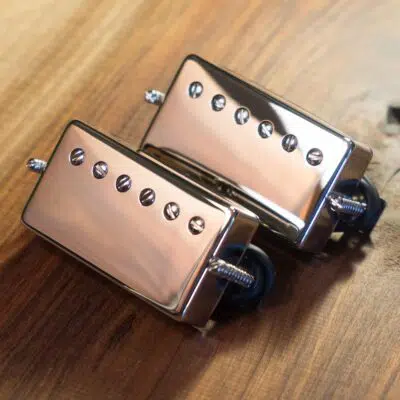
If there's one iconic guitar pickup par excellence, perhaps the most iconic in the history of the electric guitar, it's the Gibson PAF. This pickup was a true technological breakthrough upon its release. Thanks to its ingenious design, it eliminated "hum," that infamous 60-cycle hum generated by single-coil pickups. Dozens of guitarists used it on Les Pauls, SGs, and ES-335s, writing some of the most beautiful chapters in the history of 20th-century amplifiedmusic .
Among its most illustrious users are Jimmy Page, Eric Clapton, Peter Green, Mick Taylor, Mick Ronson, Gary Moore, Pete Townshend… and the list goes on. This microphone didn't just transmit the vibration of the guitar strings; no, it created a new sound, it inspired and allowed all these guitarists to create new tones, to have a different approach to their instrument. But what exactly is a PAF?
PAF, as you may already know, is the abbreviation, now an acronym, for "Patent Applied For," which roughly means "Patent filed," but not yet granted. It was therefore a generic term applied to many products for which a patent application had been filed, pending validation.
By 1955, Gibson had already created the firstelectric guitar pickup, the Charlie Christian, in the 1930s, followed by the P90 after the war. Fender had been selling the Telecaster for four years and had just launched the Stratocaster the previous year. Gibson was therefore working hard to regain market share from this new competitor.
The Gibson Les Paul was released in 1952, the year after the Telecaster, but it wasn't a success. This was despite various improvements to the tailpiece and bridge. They needed to find an innovation that would allow Gibson to establish itself in this new market of solid-body electric guitars—an area Gibson had neglected, despite Les Paul himself insisting on creating a model for it.

A Gibson engineer, Seth Lover, completely unknown to the general public, was then tasked with working on a new pickup concept.
One of the drawbacks of single-coil electric guitar pickups is the background noise they generate. This becomes very annoying when playing at high volumes and very problematic when pushing amplifiers to their limits. At the time, it was the only way to make them distort; there were no pedals available.
Seth Lover, therefore, developed what would become not only the famous PAF but also the Humbucker model that we have been using for over 65 years!

The operation of the PAF is simple, but it took some figuring out: it requires two coils, wound in the same direction. They are connected to each other at the same end, either the end of coil 1 to the end of coil 2 or the beginning of coil 1 to the beginning of coil 2. This connection between the two coils causes the electrons to rotate in one direction around coil 1 and in the opposite direction around coil 2.
The second characteristic concerns polarity, specifically the magnetized parts of the pickup. A humbucker has only one magnet. The south pole piece of the magnet is in contact with the pole pieces or screws of one coil, and the north pole piece is in contact with the screws or pole pieces of the other coil. Therefore, there is a polarity reversal between the two coils. Polarity reversal + reversal of the electron's rotation direction = humbucker. It's simple, but it took a skilled and clever electronics engineer to figure it out.
Here is a short list of the components needed to make a PAF:

Two coils made of vintage black, cream, or white butyrate plastic. This plastic has the characteristic of softening and deforming at low temperatures, below 60°C. This characteristic precludes any paraffin wax coating, which is essential for single-coil pickups, but less so for humbuckers with a vintage output level.

A fixing plate, base plate (baseplate in English) with long legs made of Nickel/silver alloy.

A 2.5″ long, 1/2″ wide and 1/8″ thick Alnico “Rough Cast” magnet bar, measuring 63.5mm x 12.7mm wide x 3.175mm thick. These dimensions are very important because the magnet's volume has a significant impact on the sound.

6 slotted cylindrical head screws (polepiece screw) of 21.75mm in 1010 steel nickel plated with a pitch of 5/40 (USA standard).

6 studs of 12.35mm + 4.75mm in 1010 nickel-plated steel

A 1010 steel spacer, drilled to allow the screws to pass through, from the spool of screws themselves
Plain enamel is the name given to the coating used in industry from the beginning of the century until the late 1960s to protect copper wire and allow it to be wound. Plain enamel is an olearesinous coating (or insulation). That is to say, it is made from natural oil and resin!
Indeed, Plain Enamel is made with linseed and tung oil cooked at high temperatures. This results in a very dark red copper wire, also known as Black Enamel. Since the recipe varied between manufacturers, wires of slightly different colors were obtained, sometimes dark red, sometimes tending towards black with red/purple highlights.
Because of its irregular appearance and limited mechanical properties, not resisting temperature variations, the industry finally abandoned it in the 1960s, replacing it with synthetic polymers.
Today, only the music industry continues to use Plain Enamel for manufacturing vintage-style pickups. The formula has been slightly modified, however, to solve a significant problem: the coating tended to crack easily, especially if the instrument was subjected to significant temperature variations. Regular transport in an airplane cargo hold, or instruments left in the trunk in the sun, was detrimental to these sensitive coils. A small amount of polyurethane is now added to stabilize the coating and prevent the short circuits that can literally destroy the coil.
This is the only component that has changed over time. There are wires coated with Heavy Formvar, polyurethane, polynylon, and polyamide. The impact of these different coatings on the sound is related to their thickness, not their composition.
* source: handbook of polymer coatings for electronics by James J. Licari & Laura A. Hughes

A maple wedge of the exact thickness of the magnet, in order to properly press the 2 coils onto the same plane at the same height.

4 brass screws to fix the coils to the base plate.

Four lead cables, approximately 5cm long, are used to connect the ends of the windings. These lead cables connect the coils to each other and to the 2-conductor braided cable.

35cm of vintage 2-conductor braided cable for connecting pickups to guitar electronics.

Between 5,000 and 6,000 turns per reel with plain enamel copper wire (see inset), 0.063mm in diameter (42 AWG US standard). There could be significant variations between pickups ; the machines weren't all identical, in terms of voltage (voltage was crucial!) and pattern consistency. They also weren't very reliable. Turns weren't counted; the reel was simply filled.
All pickups brands, including Gibson of course, offer their own reissue of the PAF, as the legendary sound of the 1958/59 Les Paul is considered the Holy Grail. So you can find everything from good to not-so-good, from very expensive to very affordable. How do you navigate this landscape, and who can you trust? Personally, I've only had good experiences with boutiquepickups , handcrafted by artisans, as industrial production simply can't produce such high-quality pickups.
Since the PAF can be made with different magnets and different output levels, I created my own reissues of the PAF.

But if only one could remain, out of all the PAF models, which one would you choose?
The answer in two words: “Burst Origin”TM
The “Burst Origin”TM, creation Cecca Guitars, features a fairly large winding, giving the pickups a rather high output level in the vintage range. The highs are bright without being harsh. The mids, for their part, are very present. The sound is full and imposing, without being bass-heavy, and it becomes raucous as soon as the overdrive is engaged. When you switch from a set of Classic 57s to the Burst Origin, you have the impression of having turned up the amp volume from 6 to 9, while still having a full, harmonically rich, balanced, and very dynamic sound.