How does a Stratocaster sound? Or more precisely: Why does a Stratocaster sound the way it does, with that characteristic snap and brightness? We could also ask this question about different guitar models. The Les Paul, the Gibson ES-335, and the Telecaster each have their own signature sound.
The unique sound of each instrument depends directly on how the guitars are constructed, as well as the woods and components used.
Let's delve into the details of this icon of electrified music since 1954.
We can note that there are several periods in the Stratocaster's history and a great many models. Consequently, the sound of a Strat can vary enormously depending on the era and the specific model. Humbuckers, Floyd Rose tremolo, exotic woods: all variations are possible for this instrument, which was designed by its creator, Leo Fender, to be modular. Here, we will focus on models from the 1950s to the late 1960s.
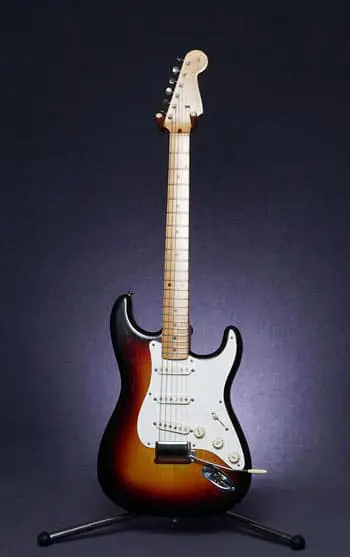

The two original woods used to make the Stratocaster are alder for the body and maple for the neck.
The alder body transmits the different frequencies in a fairly balanced way, resulting in a rather neutral tone. The maple, on the other hand, brings out the treble. The rosewood fingerboard, which appeared later in the 1960s, adds a touch more warmth to the sound.
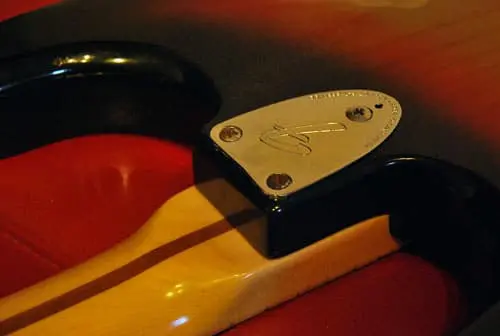
Fender guitars are characterized by the use of a bolt-on neck, unlike Gibson which uses set necks. This assembly method allows for greater modularity and facilitates production, especially later when CBS launched industrial production in the 1970s, but it also reduces the instrument's sustain.
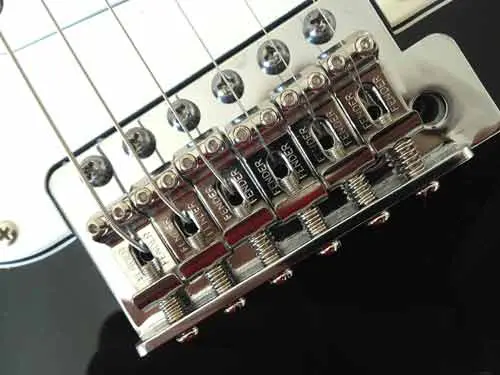
The Stratocaster features a unique vibrato system that incorporates a bridge with adjustable saddles for intonation and pitch (unlike Gretsch and Gibson guitars equipped with Bigsby tremolos, which have the vibrato block on one side and the Tune-o-matic bridge on the other). The floating nature of this vibrato reduces the instrument's overall sustain (sustain: the duration of a note).
The Stratocaster is characterized in this respect by its use of three pickups single-coil. The magnets are located in the center of the copper wire coil, unlike the P90 (its direct competitor at the time) where the two magnets are underneath the coil. The coil is taller than that of a P90 and has fewer turns (around 8000), resulting in a relatively narrow pickup surface. Because the magnetic field is therefore narrower, the resulting sound is thin, slightly scooped, and very open. These pickups have a relatively moderate output level, making them perfect for clean and crunch tones. The early models were quickly adopted by surf music players who knew how to take advantage of this snappy sound, then by blues musicians, and later by Jimi Hendrix.
While the basic structure of single-coil pickups remains the same, the individual components have varied over the years. We will analyze the first two periods here.
When the Stratocaster was first introduced, the pickups consisted of Alnico 3 magnets and Heavy Formvar wire. Alnico is an alloy primarily composed of aluminum, nickel, and cobalt, except for Alnico 3, which does not contain cobalt. This magnet is characterized by relatively low magnetic strength (and therefore a lower output level) and emphasizes the midrange frequencies. However, by the end of 1954, Fender had replaced Alnico 3 with Alnico 5, which offered a higher output level and more treble and snap. While the copper wire used for the winding remained the same, the insulating material changed. The first to be used was Heavy Formvar, which remained in use until 1964. Sonically, it emphasizes the treble frequencies. It is easily recognizable by its light orange color. The combination of Alnico 3, then Alnico 5 and Heavy Formvar wire is the true sonic signature of Stratocasters from 1954 to 1964.
In 1965, under the management of CBS, Fender's new owner, the pickups Stratocaster were modified. The magnet used remained an Alnico 5. The winding, however, was made with a copper wire called "Plain Enamel," brown/red in color, then used by Gibson for its P90s and Humbuckers.
This doesn't directly affect the sound, but Formvar, which is formaldehyde-based, was highly carcinogenic. It's the sound of Jimi Hendrix at Woodstock.