Magnets are an essential component of electric guitar pickups . Without magnets, there's no magnetic field, and therefore no sound: it's as simple as that. But how do these magnets affect the sound of pickups ? We'll analyze the different characteristics of the Alnico and ceramic magnets used in electric guitar pickups .
Most of the pickups we use are equipped with Alnico or ceramic magnets. Alnico is an acronym for the three main elements that make up this alloy: Aluminum, Nickel, and Cobalt. They also contain a very small amount of Copper, and some (6, 8, and 9) contain a little titanium. The different types of Alnico are classified by grade (1, 2, 3, 4, 5, 6, 7, 8, 9). Historically, the magnets used in the manufacture of electric guitar pickups were Alnico 2, 3, and 5. Later, Alnico 4 and 8 were incorporated. Very recently, Alnico 6 and 9 have appeared.
Each grade of Alnico has specific magnetic properties and a unique sonic character.
The output level of a microphone depends on several parameters, most notably the magnetic strength of the magnet. This is measured in gauss and varies according to the magnet's grade and size.

Alnico 2 is composed of 10% aluminum, 19% nickel, 13% cobalt, and 3% copper, with the remainder being iron. equipped pickups with Alnico 2 magnets offer moderate output with prominent mids, slightly recessed highs, and good sustain. It was very common on early pickups humbucker but wasn't used on Fender single-coil pickups, although today pickups with Alnico 2. pickups and PAF Antiquity pickups, for example, use this magnet. Along with Alnico 5, it's the most frequently used magnet for pickups humbucker. A slightly less defined sound combined with prominent mids and a moderate output level makes it a perfect choice for vintage blues/rock rhythm playing.
Alnico 3 stands apart: it contains no cobalt. It's composed of 12% aluminum, 25% nickel, and 3% copper. It's the least powerful of all the grades, but it compensates for this lack of power with a robust character. Pickups pickups this alloy are heavily focused on the low mids, giving them that characteristic husky tone and scooped upper mids. The bass is slightly recessed, but the sustain is excellent. When you crank the gain, it growls seriously, but if you ease off the gain a bit, you can easily venture into jazz, funk, or reggae, especially with humbuckers. Alnico 3 is used much less by major brands today. Gibson, for example, reserves it for the high-end models in its Custom Shop to equip its most faithful reproductions of Les Paul or ES-335 guitars (Custombucker or MHS pickups). These famous Alnico III Custombucker pickups are impossible to find commercially, and for good reason. The first single-coil Strat and Tele pickups from the 1950s used A3 magnets, then Alnico 5. Guitars equipped with pickups are therefore quite versatile in the vintage style, with a distinctive character!


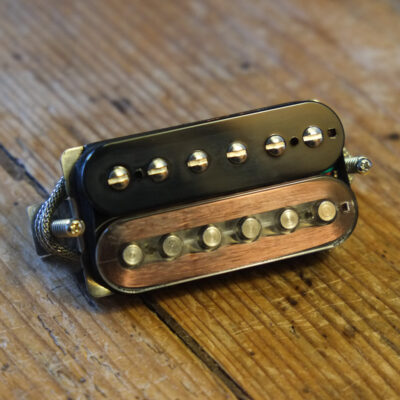
Alnico 4 is almost a newcomer, having been virtually nonexistent in the 1970s, despite embodying the DNA of the classic rock and hard rock sound of that era. It's composed of 7% aluminum, 14% nickel, 24% cobalt, and 3% copper. It has become more widespread recently and is primarily used for pickups pickups humbuckeralong with increased brightness and definition. It sits midway between Alnico 2 and Alnico 5. It's perfect for classic rock, blues, hard rock, and even metal. It handles heavy distortion very well in a more old-school style and becomes quite bluesy as soon as the guitar's volume is lowered.
It is by far the most widely used magnet in electric guitar pickup manufacturing. It boasts significant magnetic strength, well-defined bass and treble, scooped mids, and excellent definition. Sustain is slightly reduced due to its strong magnetic force. Alnico 5 can be used with all sizes and types of copper wire and handles overwinding without issue. Finally, it performs equally well in vintage and modern styles, depending on the amplifier you plug it into. It is used in most modern and Hot Vintage humbuckers. Its versatility and widespread use, however, have a slight drawback: a certain lack of originality.
Of these three alloys, Alnico 8 is the best known, even though its use remains relatively rare compared to Alnico 5. Its composition is as follows: 7% Aluminum, 15% Nickel, 35% Cobalt, 4% Copper, and, more recently, 5% Titanium. It is used as an alternative to ceramic magnets (Ceramic 8 or C8), with which it shares certain characteristics: very high output level, prominent highs, and excellent definition. My pickups equipped with Alnico 8 are designed to handle heavy distortion while maintaining clarity and definition. The clean tones are quite dry and tend to distort quickly depending on the pick attack. It's best suited for the bridge pickup, although a matched set is perfectly feasible.
Alnico 6 is even less common. Seymour Duncan included it in the Joe Bonamassa signature set for his 1958 Flying V named “Amos.” It's a magnet, falling somewhere between Alnico 5 and Alnico 8 in terms of output level. It has very present bass and slightly recessed treble compared to Alnico 5, while still maintaining a dip in the midrange. Its tone is darker than Alnico 5 and Alnico 8, yet it retains a modern sound.
It has a magnetic strength equivalent to Alnico 8 but with less treble and more pronounced midrange. This slight sonic difference brings it closer to vintage Alnico materials, but with a very high output level. It has the same composition as Alnico 8; the difference lies in the manufacturing process. It's a hybrid of Alnico 8 and Alnico 4, with which it blends perfectly in a microphone set.
We were talking about high output levels with modern Alnico coils. The C8 delivers roughly double the output of the most powerful Alnico 8. Suffice it to say, we're not even in the same league! The ceramic magnet delivers very present bass, deeply scooped mids, and piercing, even aggressive, highs. Clean tones are icy with this magnet; it's truly made for heavy distortion. It handles (and even prefers) overwinding, which will cut some highs in favor of mids, thus rebalancing the sound. If you play extreme metal, get the C8
And yes, size matters here! Let's start by comparing the magnet volume of a Stratocaster single-coil pickup with that of a humbucker and a P90. The Strat pickup consists of six cylindrical magnets of approximately 308 mm³ each, totaling 1850 mm³. The humbucker has a single rectangular magnet of 2500 mm³. The P90 has two magnets identical to those in a humbucker, for a total magnet volume of approximately 5000 mm³! The size of the magnet(s) directly influences the pickup's tone and output level. Now let's consider the Seymour Duncan Invader: it's equipped with three magnets, one of which is oversized and located in the center (the usual position for a magnet in a humbucker). The other two are on the sides and are smaller, otherwise they wouldn't fit. It has a magnet volume of 7000mm3 and has the same winding as the famous JB from the same brand.